Přejít na hlavní obsah

FAIR principles in Practice

The FAIR principles provide guidance for making research data and other digital research outputs Findable, Accessible, Interoperable, and Reusable.

What Does FAIR Mean?

F — Findable

  • Use a persistent identifier, such as a DOI.
  • Provide clear and descriptive metadata.
  • Use relevant keywords and standard terminology.
  • Deposit data in a trusted repository.

A — Accessible

  • Provide information about how and where the data can be accessed.
  • Use standard access protocols where possible.
  • Clearly state any access restrictions.
  • Keep metadata accessible even when the underlying data cannot be openly shared.

I — Interoperable

  • Use standard and widely supported file formats.
  • Use recognised vocabularies and metadata standards.
  • Provide links to related datasets and research outputs.
  • Use clear and consistent terminology.

R — Reusable

  • Provide sufficient documentation and metadata.
  • Clearly describe how the data were created or collected.
  • Include relevant licences and conditions of reuse.
  • Provide information about data quality and provenance.
FAIR at the University of South Bohemia

Researchers at the University of South Bohemia are encouraged to consider the FAIR principles when planning, managing, documenting, sharing, and preserving research data.

How FAIR are your data?

Číst dál …FAIR principles in Practice

Research Data Lifecycle

Research Data Management covers the entire lifecycle of research data — from planning and collection to storage, sharing, and long-term preservation.

At the University of South Bohemia (USB), researchers can access guidance and support throughout these stages to help them manage research data responsibly and in line with Open Science principles.

Plan

Plan how your data will be managed. Where required, prepare a Data Management Plan (DMP) .

Collect & Create

Use appropriate methods and document how the data are collected or created. Record relevant information about sources, methods, instruments, and procedures.

Organize & Document

Organize files consistently, use appropriate file formats, and create documentation and metadata that explain the data, methods, and context.

Store & Secure

Use secure and reliable storage, maintain backups, control access, and protect personal, confidential, or sensitive information.

Analyze & Use

Keep track of data processing, analysis methods, software, and versions so that the research process can be understood and, where possible, reproduced.

Share

Consider whether and how your data can be shared. Deposit suitable datasets in a trusted repository and provide appropriate metadata, documentation, and licensing information.

Preserve & Reuse

Preserve valuable research data and supporting documentation for the appropriate period. Where possible, enable others to discover, access, and reuse the data.

Číst dál …Research Data Lifecycle

Data Management Plan

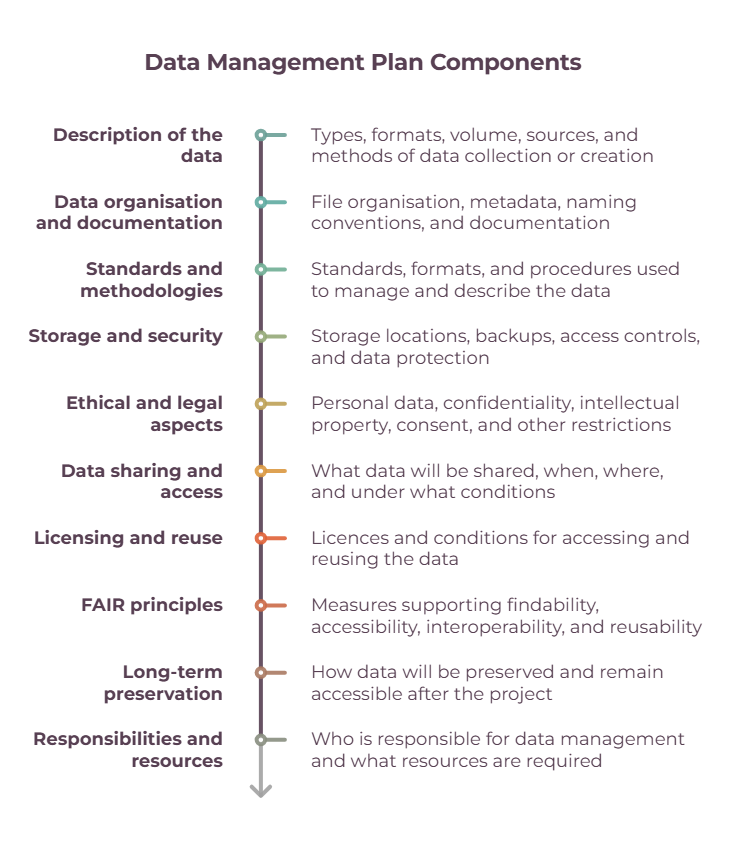
A Data Management Plan (DMP) is a document that describes how research data will be collected, processed, organised, stored, protected, shared, and preserved during and after a research project.

A DMP should be treated as a living document. It can be updated throughout the project as the research, data, or data-management practices develop.

How to Create a DMP?

There are several ways to create a Research Data Management Plan (DMP). For example, a DMP can be prepared as a Word document or created using a dedicated DMP tool. When preparing a DMP, it is recommended to follow the template and guidance provided by the relevant funder.

The format and content of a DMP may vary depending on the requirements of the funder and the nature of the research project. Always check the specific requirements of the relevant funding programme before preparing or submitting your DMP.

A practical approach is to:

  1. Identify the data — What data will be collected, created, processed, or reused?
  2. Plan data organisation and documentation — How will the data be organised, described, and documented?
  3. Plan storage and security — Where will the data be stored and how will it be protected and backed up?
  4. Consider ethical and legal requirements — How will personal, sensitive, confidential, or otherwise restricted data be handled?
  5. Plan data sharing — Which data can be shared, when, where, and under what conditions?
  6. Consider FAIR principles — How will the data be made as Findable, Accessible, Interoperable, and Reusable as possible?
  7. Plan preservation — How and where will the data and related documentation be preserved after the project?
  8. Review and update the DMP — Update the plan when significant changes occur during the project.
Tools for DMP Creation

Several tools are available to support the creation and management of a Data Management Plan (DMP). These tools guide researchers through the DMP creation process, support collaboration and shared editing within the project team, and help produce a final DMP using templates recommended by different funders and funding programmes.

DMPonline is an online tool for creating and managing Data Management Plans.

Data Stewardship Wizard (DSW) is an open-source tool that supports researchers throughout the planning and management of research data. It guides users through the DMP creation process using structured questions and can generate DMPs based on different templates and requirements.

ARGOS is a web-based tool for creating and managing Data Management Plans. It is integrated with the OpenAIRE platform and supports the creation of machine-actionable DMPs.

DMP Templates

Use the template required or recommended by your funder or funding programme. The following templates can be useful starting points:

The European Commission provides a Data Management Plan template for Horizon Europe.

TA ČR provides requirements and templates for Data Management Plans for its funded projects.

Národní technická knihovna, Data Management Plan template.

Číst dál …Data Management Plan

Data Collection

Data may be collected or generated through a wide range of methods, including experiments, observations, measurements, surveys, interviews, fieldwork, simulations, archival research, or the use of existing datasets and other sources.

What to Consider When Collecting Data?

When planning and carrying out data collection, researchers should consider:

  • Type and scope of data — What data will be collected or generated, and in what volume?
  • Collection methods — Which methods, instruments, tools, or procedures will be used?
  • Data quality — How will the accuracy, consistency, and quality of the data be ensured?
  • Documentation — How will the collection process, methods, instruments, and decisions be recorded?
  • File formats — Which appropriate and sustainable formats will be used?
  • Ethical considerations — Are informed consent, ethical approval, or other safeguards required?
  • Legal requirements — Are there requirements related to personal data, confidentiality, intellectual property, or other restrictions?
  • Storage and security — Where will the data be stored during collection, and how will it be protected and backed up?
  • Reuse of existing data — If existing datasets are used, are their sources, licences, and conditions of reuse documented?

What to Document During Data Collection?

During data collection, consider documenting:

  • What was collected — type, scope, volume, and source of the data.
  • How it was collected — methods, protocols, procedures, instruments, and tools used.
  • When and where — dates, locations, and relevant environmental or experimental conditions.
  • Who collected the data — researchers, research teams, or other contributors, where relevant.
  • Data formats — file formats and structures used to store the collected data.
  • Data quality — quality-control procedures, validation, checks, and any identified issues.
  • Changes and deviations — changes to the planned methodology or data-collection procedures.
  • Data processing — any cleaning, transformation, coding, or other processing carried out during collection.
  • Ethical and legal considerations — consent, anonymisation or pseudonymisation, confidentiality, and other restrictions where applicable.
  • Supporting documentation — codebooks, questionnaires, protocols, metadata, notes, or other information needed to understand the data.

Good practice: Maintain documentation throughout the data collection process. Timely and consistent recording of relevant information supports effective data management and facilitates the subsequent analysis, verification, sharing, and reuse of research data.

Číst dál …Data Collection

Data Storage & Backup

Appropriate storage and regular backup of research data are essential for protecting data from loss, damage, unauthorised access, or accidental deletion.

Data Storage

Researchers should select storage solutions that are appropriate for the type of research data and the requirements of the project. When choosing a storage location, consider:

  • Security — Protect data against unauthorised access, loss, alteration, or disclosure.
  • Access control — Ensure that only authorised members of the research team can access the data.
  • Reliability — Use reliable storage with appropriate availability and maintenance.
  • Capacity — Ensure sufficient storage capacity for the expected volume of data.
  • Data protection — Apply appropriate measures when working with personal, confidential, or sensitive data.
  • File formats — Where appropriate, use open or widely supported formats to facilitate long-term access and reuse.
  • Documentation — Keep information about the storage location, access permissions, and relevant data-management procedures.

Research data should not be stored solely on individual computers, laptops, external drives, or other single storage devices where their loss or failure could result in permanent data loss.


Data Backup

A backup strategy should consider:

  • Regular backups — Back up data at appropriate intervals according to the frequency of data creation and modification.
  • Multiple copies — Maintain more than one copy of important research data.
  • Separate locations — Where appropriate, keep backup copies in a separate physical or technical location from the original data.
  • Automated backups — Use automated backup solutions where available and appropriate.
  • Backup testing — Periodically verify that backups are complete and can be successfully restored.
  • Access protection — Protect backup copies with appropriate access controls and security measures.
  • Retention — Define how long backup copies should be retained in accordance with project requirements.
The 3-2-1 Backup Rule

It recommends keeping:

  • 3 copies of important data — the original data and at least two backup copies.
  • 2 different storage media or storage environments — for example, institutional storage and a separate backup system.
  • 1 copy in a different location — an off-site or otherwise geographically separate backup that is protected from incidents affecting the primary location.

Číst dál …Data Storage & Backup

Přihlaste si
odběr newsletteru

Zůstaňme v kontaktu na
sociálních sítích

Branišovská 1645/31a, 370 05 České Budějovice Tel.+420 389 032 191 | Tato e-mailová adresa je chráněna před spamboty. Pro její zobrazení musíte mít povolen Javascript.

Branišovská 1645/31a, 370 05
České Budějovice
Tel.+420 389 032 191 Tato e-mailová adresa je chráněna před spamboty. Pro její zobrazení musíte mít povolen Javascript. www.jcu.cz

© Jihočeská univerzita v Českých Budějovicích
Cookies