





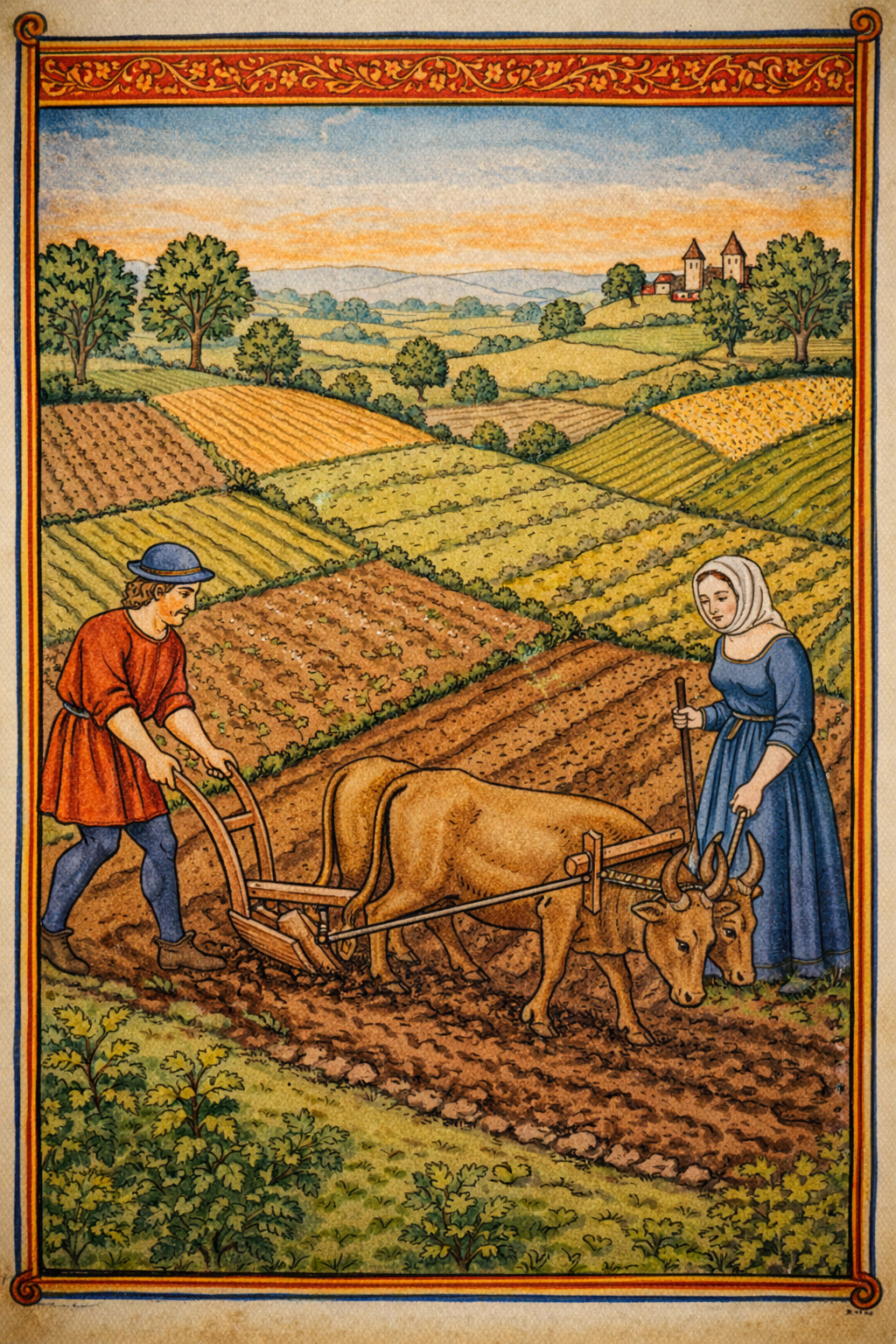

Why did monogamous marriage become established in some societies, despite the fact that the majority of human cultures historically permitted polygyny? A new international study led by scientists from the Faculty of Science at the University of South Bohemia shows that the main reason was not an attempt to limit violence or increase social stability, but rather competition over inherited property – particularly agricultural land.
Anthropological data show that more than 80% of historically documented human societies permitted polygyny. It occurs more frequently where there are significant differences between men in terms of health, wealth, and social status. Previous research suggests that on a global scale, these differences are caused primarily by the prevalence of infectious diseases and the level of violence in society. Under such conditions, it may be advantageous for women to live in polygynous marriage – that is, to share a partner who is healthy, wealthy, and capable of providing women and children with protection and material security. All the more puzzling, then, is why a relatively small number of societies – and often precisely those that are the wealthiest, most complex, and characterized by the highest degree of social inequality – established monogamy as a legally enforced norm.
Previous debates have offered two main explanations for this paradox. According to the first theory, monogamy was supposed to reduce the number of unmarried men, limit violence, and strengthen cooperation, thereby increasing social stability. The second theory focuses on families and inheritance: with the development of agriculture and the decline of free land, property became a resource that loses value if divided among many wives and heirs. Scientists from the University of South Bohemia, together with colleagues from Britain and Switzerland, compared these two theories systematically for the first time using global ethnographic data. Using causal models and Bayesian phylogenetic analyses, they analyzed a dataset of nearly 200 societies from across the world – from hunter-gatherer groups to historical state entities.
"Both of these theories are intuitively understandable and frequently appear in discussions about the origins and significance of the institution of marriage. However, they are based predominantly on the historical reality of European societies, which is understandable because monogamy spread in Europe in ancient times. At the same time, we know that monogamy emerged repeatedly in different parts of the world outside the Indo-European cultural sphere," explains the lead author of the study, Pavel Duda from the Faculty of Science at the University of South Bohemia.
The results show that monogamy is strongly associated across societies with the privatization of land and with ecological factors that make land scarce. Conversely, the presumed social benefits of monogamy – the reduction of violence or the strengthening of cooperation – were not systematically confirmed in the data. The study, published in the journal Proceedings of the National Academy of Sciences (PNAS), thus suggests that monogamy as a social norm emerged repeatedly as an adaptation to problems of inheritance and intergenerational competition over limited resources, rather than primarily as a tool for stabilizing society.


